You know the cycle. You sit down to work, open your laptop, and suddenly you're three tabs deep into something completely unrelated. Twenty minutes vanish before you even touch the actual task. Procrastination isn't usually about laziness—it's about friction. Getting started feels harder than staying distracted. That's exactly where a structured work rhythm matters, and where Focusly tries to step in.
What Focusly Actually Does
Focusly is a Pomodoro timer app built around deep work sessions. The core idea is simple: you plan your work in timed blocks, the app tracks those blocks, and you commit to staying inside them. It's not just a countdown clock on your screen. Focusly asks you to define what you're working on before the timer starts, which forces a micro-decision that cuts through the "I'll just figure it out as I go" fog.
Sessions are customizable. You can stick with the classic 25-minute Pomodoro, but you can also stretch to 45 or 90 minutes if your work needs longer uninterrupted runs. The rest intervals adjust accordingly. After a session ends, the app logs what you did and how long you spent, so over a week you actually see where your time went—not where you vaguely think it went.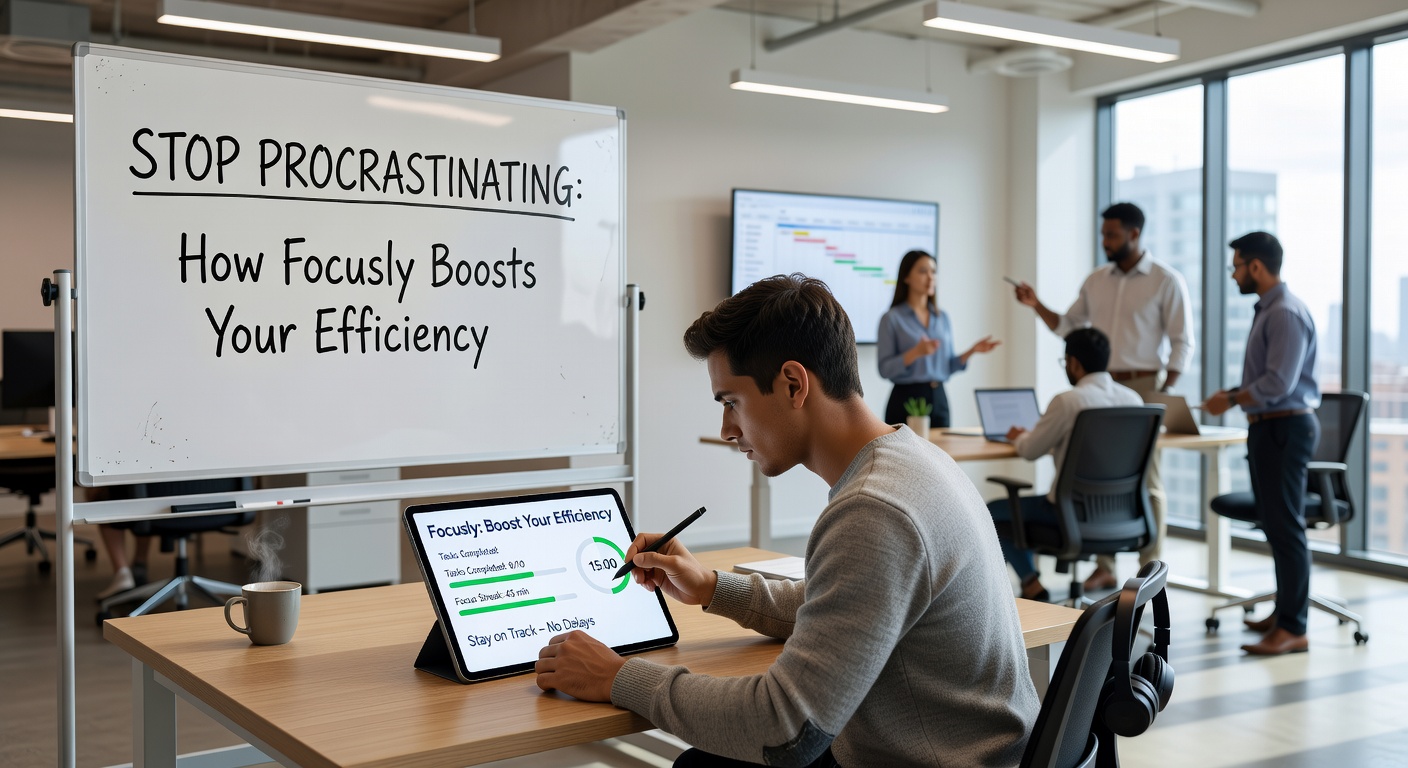
When It Clicks
Focusly works best when the problem isn't complex task management but plain resistance to starting. A few scenarios where it genuinely helps:
The blank-page freeze. You have a report to write and keep reorganizing your desktop instead. Setting a 25-minute Focusly session with the label "draft intro section" gives you a container. The timer running is a low-pressure commitment—you only have to survive 25 minutes, not "finish the whole thing." That reduced scope makes starting easier.
The study spiral. You're reviewing material for an exam and keep switching between topics because nothing feels "done." Focusly's session planning lets you lay out three 30-minute blocks in advance: one for reading, one for note synthesis, one for practice problems. You stop renegotiating your plan every ten minutes.
The afternoon slump. Around 2 PM your focus dissolves and you start refreshing email obsessively. A short 15-minute Focusly block with a specific task—"review two pull requests"—can push you through that dead zone without requiring heroic willpower.
In each case, the app isn't doing the work for you. It's reducing the decision fatigue that leads you to procrastinate in the first place.
Tradeoffs and Realistic Limits
No timer app fixes procrastination if the underlying issue is that you genuinely don't know how to approach the task. If you're avoiding something because it's poorly defined or you're missing key information, Focusly's structure just makes you sit there feeling stuck for 25 minutes. You still need to break ambiguous work into concrete subtasks before the timer adds value.
The app also assumes you can tolerate working in timed compartments. Some people find countdown timers anxiety-inducing rather than motivating—if watching the clock makes you rush or freeze, Pomodoro-style constraints may backfire. In that case, a simpler time tracker where you log work after the fact (like Toggl) might fit better than a pre-planned session tool.
Compared to alternatives, Focusly sits between minimal timer apps and heavy productivity systems. It's more structured than a basic stopwatch, but it doesn't try to be a full task manager with projects, subtasks, and deadlines. If you already live inside Notion or Todoist for planning, Focusly handles the execution rhythm layer. If you want everything in one app, you'll feel the gap.
Building a Rhythm That Sticks
The real benefit of Focusly shows up after a few days of consistent use, not in the first session. Your brain starts recognizing the timer as a trigger—"this block is for working, not for wandering." That pattern is what actually reduces procrastination over time. The app's session history lets you see whether you're improving or still losing half your planned blocks to interruptions, which is useful feedback that most people otherwise never track.
Focusly won't make you immune to distraction. Your phone still buzzes, Slack still pings, and you still have to choose to ignore those during a session. But it gives you a clear structure to return to when you slip, instead of drifting for an hour before realizing you've accomplished nothing. That's the practical edge: not perfection, but a recoverable rhythm.
Comments
Leave a Comment