I remember the exact moment I realized my attention span was broken. It was 3 PM on a Tuesday, I had three browser tabs open, Slack was pinging every ninety seconds, and I'd just instinctively picked up my phone to check Instagram—for the fourth time in an hour. The worst part? I couldn't even remember what I was supposed to be working on.
That week, I started coding the first prototype of what would become Focusly. Not because I wanted to build another productivity app—there are already hundreds of those. But because every existing solution felt like it was designed for someone who already had their act together. I didn't need another dashboard with charts showing how badly I'd failed. I needed something that worked with my brain, not against it.
The problem with most Pomodoro timers
Traditional timers treat you like a robot. Twenty-five minutes on, five minutes off, repeat until burnout. But the reality of deep work is messier. Some tasks need forty-five minutes of uninterrupted flow. Others hit a natural stopping point at eighteen minutes. And sometimes, the hardest part isn't staying focused—it's deciding what to focus on in the first place.
Focusly's approach is different because it's built from the messiness out. Instead of locking you into rigid intervals, it lets you plan sessions around your actual work rhythm. You set a target for the session—maybe "finish draft outline" or "refactor payment module"—and the timer bends around that goal, not the other way around. The distraction blocking is embedded, not bolted on as an afterthought.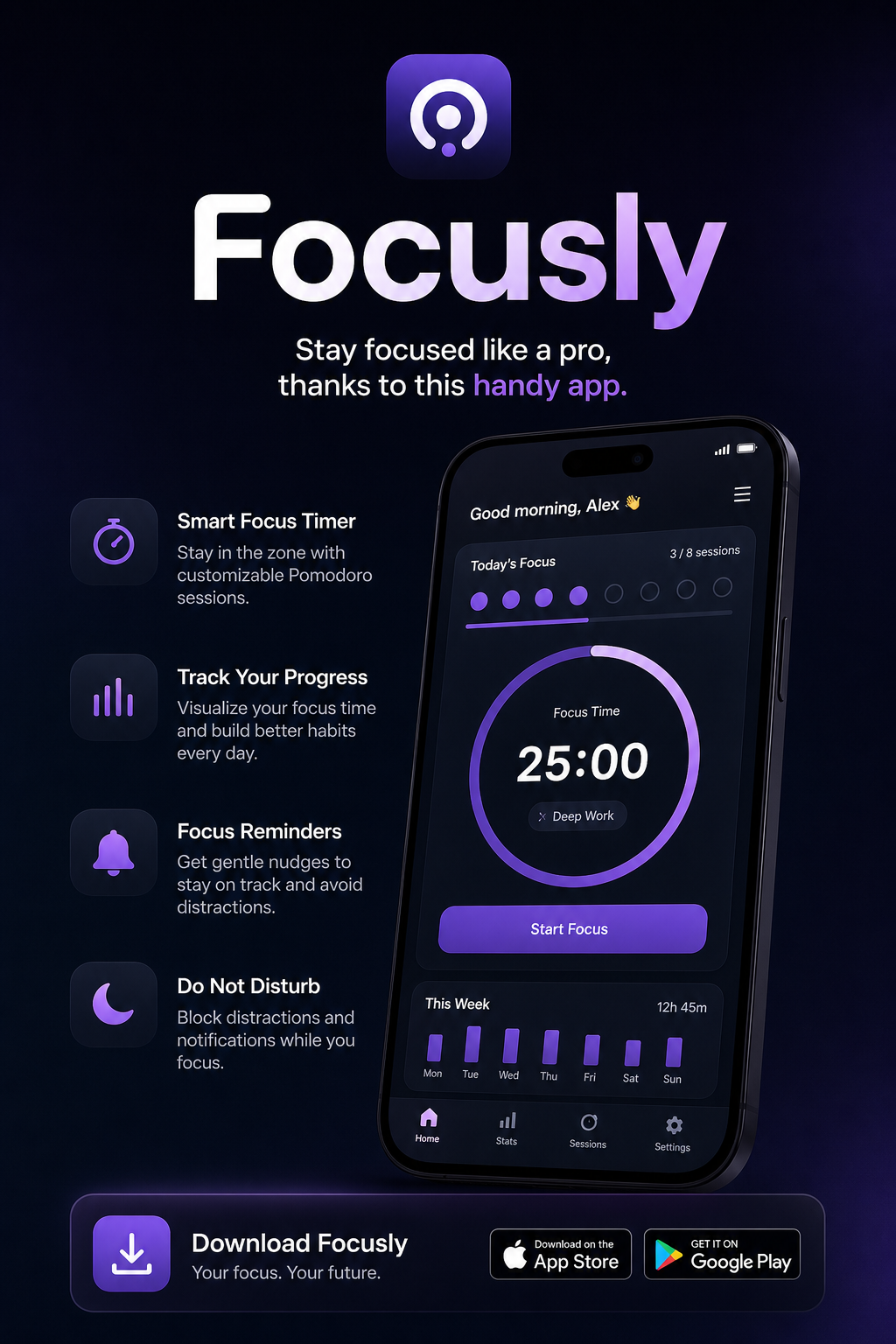
Three scenes where Focusly actually helped
One of the first beta testers was a freelance graphic designer named Kate. Her problem wasn't motivation—it was scope creep. She'd open Photoshop to design a logo and somehow end up researching font history for two hours. With Focusly, she started setting session targets before opening any software. The timer reminded her she wasn't "exploring"—she was delivering a specific outcome.
Another tester was a master's student struggling with thesis writing. He'd sit down at his desk, open his document, and immediately find ten other things to arrange: organizing PDF folders, cleaning his keyboard, checking if any coffee shops had new menu items. Focusly's planning step forced him to write down one concrete sentence about what he'd accomplish in the next session. That tiny act—typing a goal before hitting start—changed his entire approach.
Then there was the remote engineering team that tried using Focusly for paired debugging sessions. They'd sync their timers, mute notifications, and work in focused blocks with a shared Slack status that read "Deep work until :15." The ritual itself became a signal: we're in this together, don't break the bubble.
Where Focusly might not fit—and that's okay
Let me be honest about the limitations. Focusly isn't designed for people who need rigid structure imposed from the outside. If you thrive on strict schedules with alarms that punish you for drifting, this app might feel too flexible. The customization is intentional: it gives you control, but control requires self-awareness.
It's also not ideal for team-based accountability if your coworkers aren't using it. The solo mode is strong; the shared sync features are still maturing. If your primary need is "my whole team must use the same focus tool," Focusly probably isn't the answer today.
And if you're looking for gamification—points, levels, leaderboards—Focusly doesn't have those. I made a deliberate choice to leave them out. Gamification works for habit formation, but deep work isn't a game. The reward is the work itself getting done, not a virtual badge.
What it feels like to use Focusly for a week
The first day feels weird. You have to plan before you start. That friction is intentional—it trains your brain to shift from reactive mode to deliberate mode.
By day three, you notice yourself reaching for your phone less. Not because Focusly blocked it (though it can), but because you've built a small momentum. The session targets help you remember what you're even doing.
By day five, a subtle change happens: you start feeling restless when the timer isn't running. Not in a frantic way—more like your brain has started associating focus time with a sense of progress. That's the rhythm I wanted to build. Not discipline through punishment, but consistency through clarity.
If you're stuck in the cycle of wanting to focus but constantly falling out of it, Focusly might help. It won't fix everything—no app can. But it's one less excuse to let the next notification steal your attention.
Comments
Leave a Comment