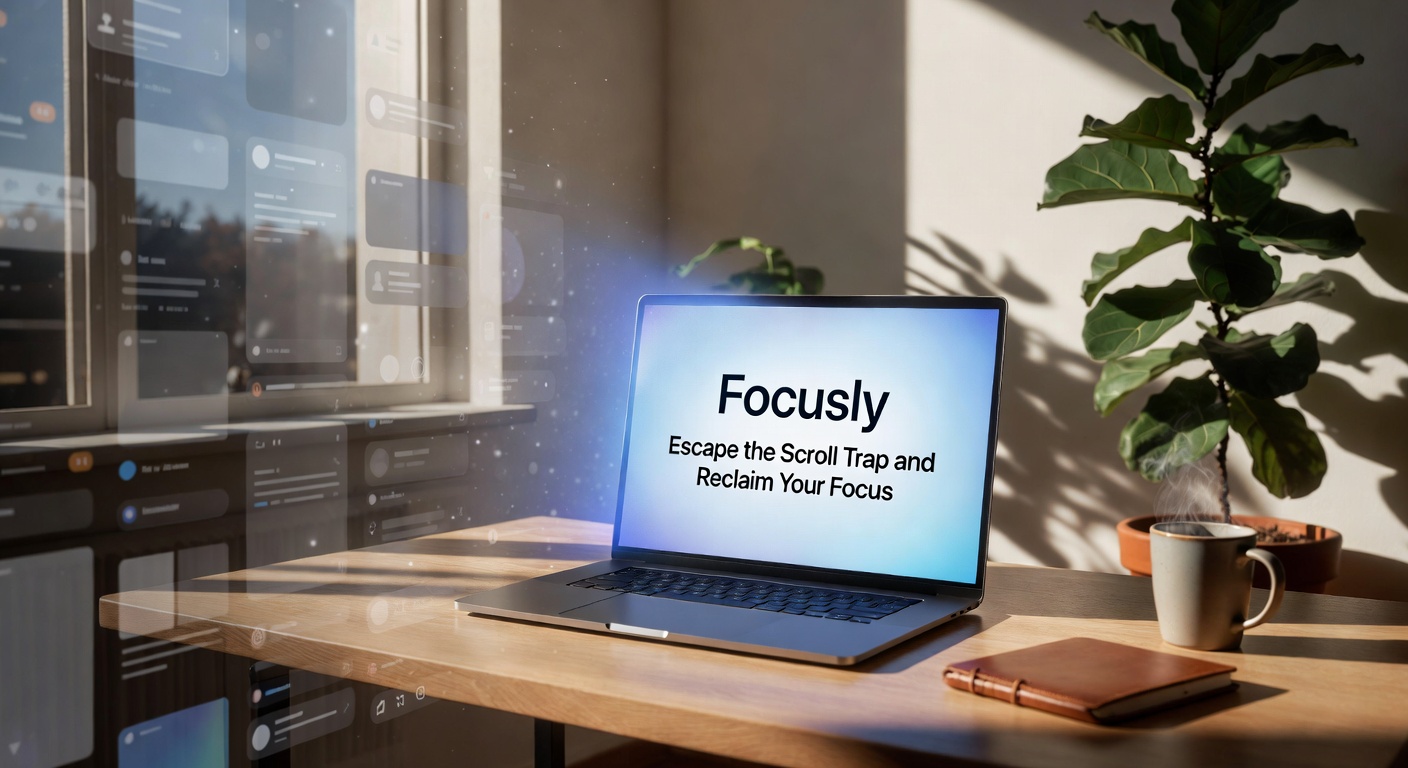
You know the pattern. You sit down to work, open your phone to check one thing, and twenty minutes later you're three reels deep into someone's kitchen renovation in Portugal. The scroll trap isn't a character flaw—it's an architecture problem. Your brain defaults to low-effort high-dopamine loops when you haven't built a clear structure for doing the hard stuff. That's where a focused work timer stops being a novelty and starts being the scaffold you actually need.
What Focusly Does Differently
Focusly is a Pomodoro-style timer built around deep work sessions rather than generic task tracking. You plan your blocks—say, two 50-minute sessions for a report, one 25-minute session for emails—then hit start. The app locks the rhythm: work period, break, next work period. No manual resetting between rounds, no fiddling with durations mid-session.
The core idea is simple: reduce the decision points. Every time you pause to ask "should I keep going or check Slack?" you've already lost. Focusly removes that micro-decision by keeping the timer visible and the session plan fixed. Your only job is to sit there until it rings.
The session planning layer is what separates it from a basic countdown clock. You map out the day's structure before you start—three deep blocks, two shallow blocks, whatever matches your workload. Once the plan is set, you execute. It's a small shift, but it changes the app from a stopwatch into a work rhythm builder.
Real Scenarios Where It Clicks
The post-lunch slump. You come back from lunch, energy is flat, and the easiest move is opening social media. If you've already queued a 25-minute Focusly block for "review pull requests," the timer is sitting there waiting. You start it because starting is the only option presented. Five minutes in, you're actually working.
Long writing sessions. A 50-minute block with a 10-minute break matches how most people can sustain writing intensity. Three of those blocks in a row—roughly three hours with breaks built in—gets you through a draft. You're not watching the clock or guessing when to stop. The app handles the cadence.
Study blocks with spaced breaks. If you're grinding through exam prep, the 25/5 default fits well. You can stack four blocks, take a longer 15-minute break after the set, then start another round. The structure prevents the "I'll just keep going until I burn out" approach that sounds productive but leaves you useless after two hours.
Tradeoffs and Fit
Focusly trades flexibility for commitment. Once a session starts, you're in it. You can abandon a block, but the app doesn't make that frictionless—and that's intentional. If you need a timer that lets you pause anytime, restart freely, or switch between tasks mid-session, this rigidity will feel annoying. It's built for people who know their biggest problem is self-interruption, not external interruption.
The app also assumes you can roughly predict your work structure. If your day is pure reactive chaos—constant incoming requests, unpredictable meeting drops—planning blocks in advance won't match reality. You'll end up abandoning sessions or ignoring the timer. In that environment, a simpler countdown tool you can grab on the fly works better than a pre-planned session stack.
Compared to alternatives: Forest gamifies focus with tree growth, which works if visual rewards motivate you. Be Focused gives you lightweight Pomodoro tracking without the session-planning layer—faster to start, less structure. Focusly sits in the middle: more scaffolding than a bare timer, less gamification than Forest. You pick it when you want the plan to exist before the work starts.
Escaping the Scroll Trap
The scroll trap wins when there's no competing structure. Focusly doesn't magically make Instagram less interesting. It makes the alternative—starting a planned work block—visible and low-effort. The timer is already queued. The session is already named. You just press start and ride the rhythm you set earlier.
That's the practical shift. You stop negotiating with yourself every fifteen minutes. The negotiation happened once, when you built the session plan. The rest is execution. If your focus problem is that you can't start, or you can't sustain, or you keep drifting into low-effort scrolling between tasks, a rigid session structure is the thing that closes those gaps. Focusly builds that structure directly into the timer. It's not the only way to solve the problem, but it's a clean one—plan once, then follow the clock until the work is done.
Comments
Leave a Comment