You’ve probably tried to build a deep work routine before. Maybe you started strong, but by day three, your attention was back to scrolling. The problem isn’t willpower—it’s that most productivity tools treat focus as a one-time event rather than a habit you can actually measure and extend over time.
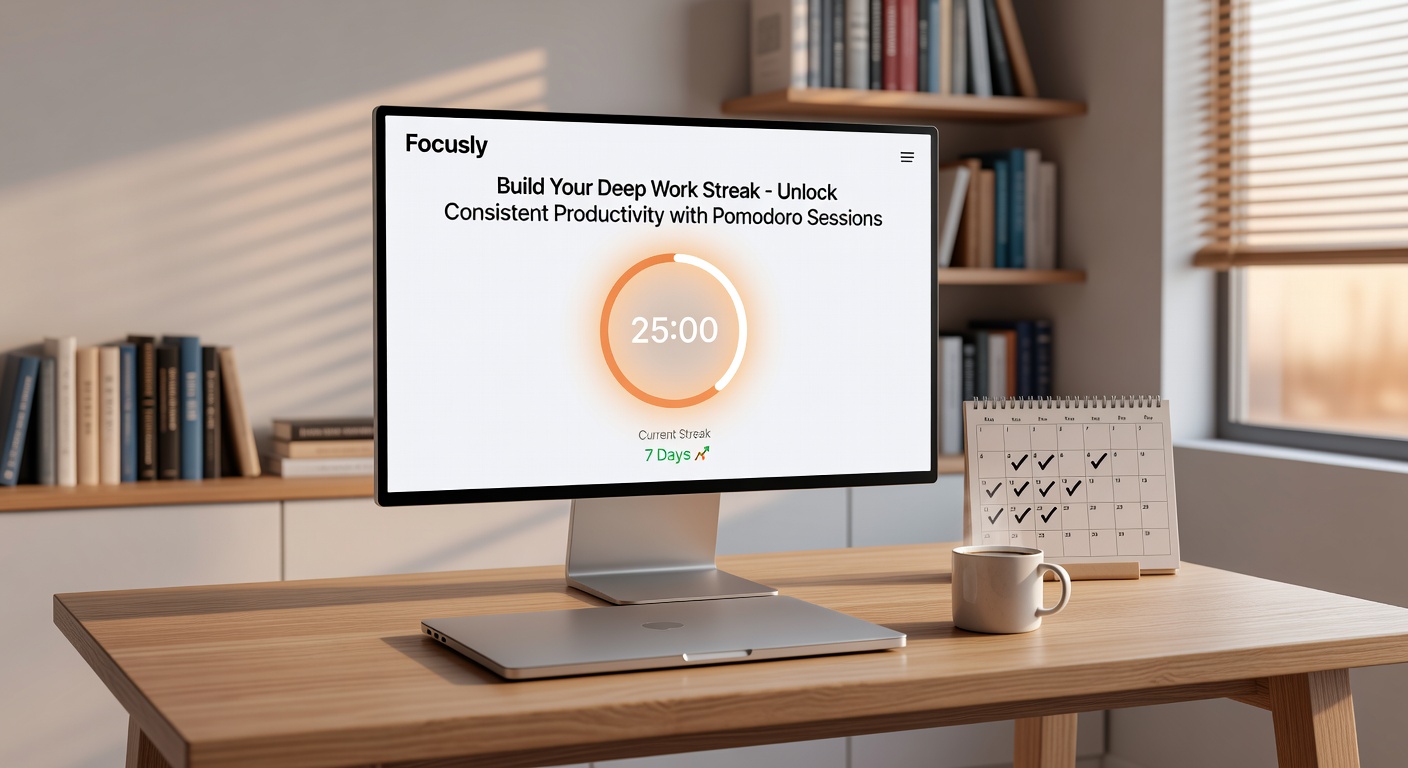
Focusly tries to fix that by turning Pomodoro sessions into something closer to a streak system. Instead of just timing your work, it pushes you to string sessions together across days, weeks, and months. The core mechanic is simple: you set a timer (typically 25 or 50 minutes), work without interruption, and log that session. If you do it again the next day, your streak grows. Miss a day, and it resets.
Why the streak model actually works here
Most Pomodoro timers treat each session as isolated. You finish one, get a checkmark, and move on. Focusly adds a layer of continuity that changes the psychological reward. When you see a streak of 7 or 14 days, you start to treat each session as part of a longer story. The motivation shifts from “I need to finish this task” to “I don’t want to break my record.” That feeling is real, and it’s harder to replicate with a plain stopwatch.
I tested it over two weeks with writing and coding tasks. The first few days felt the same as any other timer. Around day five, I noticed myself automatically reaching for the app before starting work. By day ten, skipping a session actually felt uncomfortable. That’s the kind of friction that builds genuine habit momentum.
Realistic scenarios where Focusly helps
Consider a remote worker who struggles with afternoon slumps. Instead of relying on caffeine or willpower, they schedule a single 25-minute Focusly session right after lunch. The streak logic keeps them honest because skipping two days in a row means starting over. That simple social contract with yourself is surprisingly effective.
For students preparing for exams, the app works well when paired with subject blocks. You can allocate sessions to math, then language, then revision, and track which subjects get the most consistent attention. Over a semester, the streak data becomes a reliable measure of study discipline—more concrete than a vague feeling of “I worked hard this week.”
Freelancers and creatives often face the opposite problem: they work in bursts but can’t sustain output. Focusly’s streak helps smooth out those peaks and valleys. Even a short 15-minute session counts toward the streak, which lowers the barrier to starting on low-energy days.
Tradeoffs and fit: where Focusly might fall short
Not every work style fits the streak model. If your work is heavily reactive—customer support, emergency response, live events—you can’t always control when you focus. Forcing a streak in that context leads to frustration and guilt. Focusly works best when you have predictable, uninterrupted blocks you can dedicate to deep work.
Also, the app doesn’t solve the quality problem. Logging a session at 50 minutes means nothing if you spent half of it distracted. The streak only measures time, not attention depth. You’ll still need to practice single-tasking on your end.
Finally, if you already use a full task management system like Todoist or Notion, adding another app can feel like overhead. Focusly isn’t a replacement—it’s a complementary habit tracker. If you prefer all-in-one tools, the separation might annoy you.
A practical way to evaluate fit
Before committing, try a 7-day experiment. Use Focusly for one session per day, ideally the same time and context. At the end of the week, ask yourself two questions: Did I look forward to the session? Did the streak motivate me on days I felt lazy? If the answer to both is yes, the app will likely serve you well. If not, you might be better off with a simpler timer or a different habit framework entirely.
Focusly doesn’t reinvent productivity, but it gives you a clear, low-friction way to build consistency. In a world full of distraction, a small daily win—visible and countable—can be exactly what you need to keep showing up.
Comments
Leave a Comment