Let’s be real—heavy workloads don’t care about your motivation. They just pile up. And somewhere around 3 PM, your brain starts buffering like a 2015 laptop trying to run Chrome with 40 tabs open.
I’ve been there. Midterms, side gig deadlines, that freelance project you said yes to because rent exists. For a while, I just accepted that focus was a finite resource that ran out by noon. But then I started using Focusly Deep Work—a pomodoro timer app that somehow made my concentration outlast my energy drinks.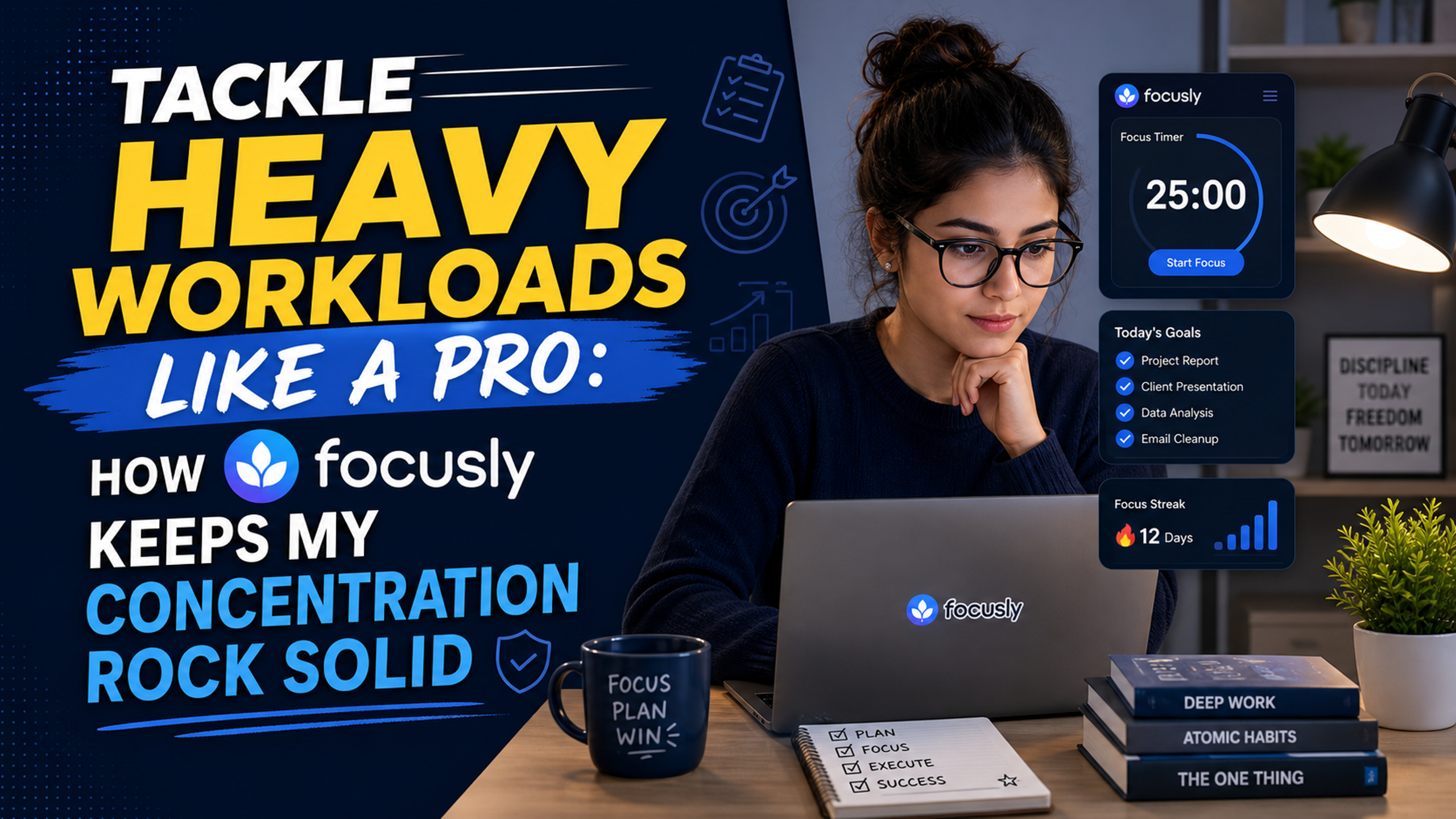
My attention span was embarrassing
Before Focusly, I worked in these long, punishing blocks. Two hours straight, then wonder why I’d hate everything after 45 minutes. Classic rookie mistake. Focusly flipped that. It’s not just a timer; it helps you plan actual sessions based on how long your brain can realistically stay useful.
I set a 50-minute deep work block for writing a product brief. Phone face down, laptop notifications off, Focusly running. When the timer ended, I had done more in that 50 minutes than in the entire previous afternoon. The app’s structure—plan, work, short break—mapped onto how my focus actually behaves, not how I wish it did.
Three scenarios where it saved my day
Scenario 1: The 10-tab rabbit hole I was researching for a grad paper. One link led to another, and suddenly I was reading about 14th-century trade routes (my paper was on satellite communications). I opened Focusly, set a 25-minute session, and labelled it “research—stick to sources.” Knowing the timer was counting down killed the infinite scroll instinct.
Scenario 2: Back-to-back Zoom fatigue After four calls, my brain was static. I used Focusly’s quick 10-minute “reset” mode. No deep work, just sitting in silence with a timer. It sounds stupidly simple, but having the app enforce that break made me take it seriously.
Scenario 3: Late-night coding I’m not a developer, but I maintain a small site. At midnight, every fix looks like ten new problems. Focusly helped me break tasks into 30-minute chunks. I told myself: “Just 30 minutes on the CSS issue.” Often that was enough, or at least enough to get past the scary part of starting.
But it’s not perfect—here’s the tradeoff
Focusly works best when you have one main task. If your workload is chaotic—switching between Slack, email, and three projects constantly—the structured sessions can feel restrictive. There were days I’d finish a focus block and realize I should have been doing something completely different. The app doesn’t fix what to work on; it only helps you stay on what you chose. That’s on you.
Also, the planning feature needs a few minutes upfront. If you’re in “reflex mode” where you just react to whatever’s loudest, it feels like extra friction. I had to unlearn the habit of diving straight into work before opening the app. Once that clicked, the friction turned into a benefit.
Who should actually use this
If you have a predictable workload—writing, coding, studying, designing—and you struggle to sustain focus for more than 20 minutes, Focusly is a real upgrade. You’ll notice the difference in a week. If your work is purely reactive (customer support, urgent tasks dripping in all day), you’ll fight the structure more than enjoy it. In that case, you might want a simpler timer or even just the default phone clock.
Bottom line
I went from “I’m busy all day but got nothing done” to finishing my actual priorities before lunch. Focusly keeps my concentration rock solid because it forces me to stop lying about how long I can work effectively. Heavy workloads don’t care about your effort—they care about your output. This app tipped the scale for me.
Comments
Leave a Comment